



Have you ever walked into a conversation with a contractor or interior designer, felt confident about your project, and then suddenly frozen when they asked, “So, are we looking at a full fit out here, or just a renovation?”
It happens more often than you think. While the terms are often tossed around interchangeably in casual conversation, in the construction and design world, they mean very different things. Confusing them can lead to wildly inaccurate quotes, misunderstood timelines, and a final result that doesn’t match your vision.
Don’t worry. We are going to strip away the industry jargon and explain this simply. By the end of this guide, you’ll know exactly what your building needs and how to ask for it.
TL;DR
The Core Difference:
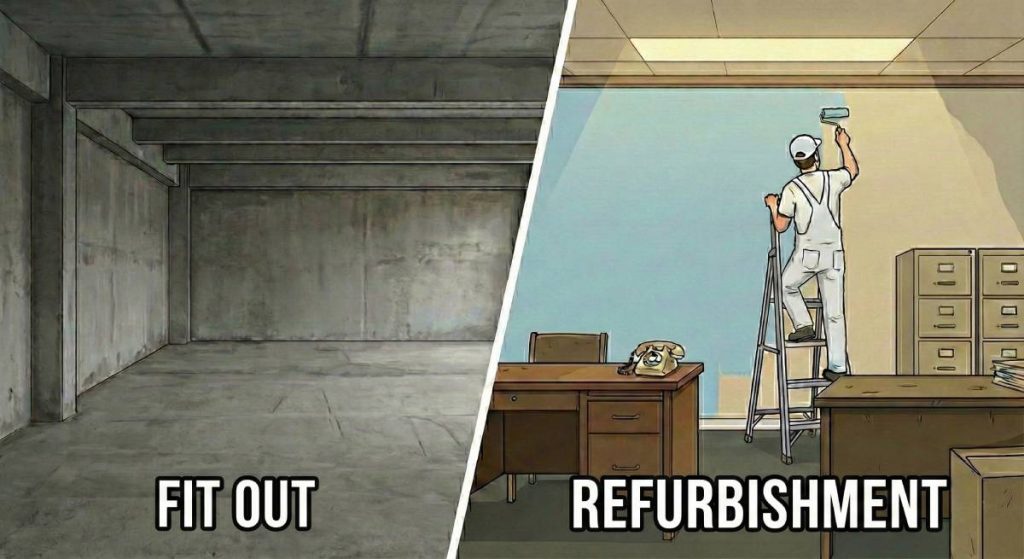
A Fit Out is the process of making an interior space suitable for occupation. It usually involves developing a “blank canvas” (like a concrete shell) into a working office or store.
A Renovation (or refurbishment) is the process of improving a building that is already in use. It involves restoring, repairing, or updating existing structures and aesthetics.
The Simple Analogy: Explain Like I’m 5
Construction terms can be dry. Let’s use an analogy to make it stick.
Think of it like buying a computer:
- The Fit Out: Imagine buying a brand-new computer tower. It has a metal case and the power supply, but no hard drive, no operating system, and no software. You have to install the “guts” to make it work for you. You are building from the inside out.
- The Renovation: Imagine you have an old computer that works, but it’s slow, and the case is scratched. You decide to upgrade the RAM, wipe the hard drive, and put stickers on the case. You are improving what is already there.
What is a Fit Out?
The term “Fit Out” is used almost exclusively in commercial real estate (offices, retail stores, restaurants).
Developers often build the “shell” of a building, the concrete floors, walls, and windows, but they leave the inside empty. Why? Because a lawyer’s office needs a totally different layout than a yoga studio.
A fit out fills that empty shell.
The Three Levels of Fit Out
To sound like a pro, you need to know these three terms:
- Shell & Core: This is the bare bones. Concrete floors, elevator shafts, and lobbies. It is uninhabitable.
- Cat A Fit Out (The Basics): This is usually what the landlord provides. It includes functional features like:
- Raised floors and suspended ceilings.
- Basic mechanical and electrical services (AC, lighting).
- Toilets and fire detection systems.
- Cat B Fit Out (Your Personality): This is where you come in. This makes the space yours. It includes:
- Internal partition walls to create meeting rooms.
- Branding, furniture, and reception areas.
- Kitchenettes and breakout zones.
- IT infrastructure and specialized lighting.
Key Takeaway: If you just leased a new office floor and it looks like a big empty hall, you need a Cat B Fit Out.
What is a Renovation?
Renovation is about giving a tired space a facelift. The bones of the building are already there, but they might be outdated, damaged, or just ugly.
Renovations are usually cosmetic or restorative.
Typical Renovation Tasks Include:
- Repainting walls and ceilings.
- Replacing old flooring (carpet to timber).
- Upgrading fixtures (new lights, new taps).
- Knocking down a non-load-bearing wall to open up a room.
- Repairing rot or damage.
Repainting is the easiest way to transform a space, but it requires accurate budgeting. Before you buy materials, make sure you know how to calculate paint quantities effectively so you don’t overspend on wastage.
Comparison Table: Scope, Cost, and Timeline
This table will help you decide which path fits your current situation.
| Feature | Fit Out | Renovation |
| Starting Point | Usually an empty “Shell” or “Cat A” space. | An existing, fully furnished space. |
| Primary Goal | To create a functional space from scratch. | To update, repair, or modernization a space. |
| Common Activities | Installing walls, power, data, ceilings, HVAC zones. | Painting, flooring, minor repairs, furniture upgrades. |
| Cost | Generally higher due to extensive construction. | Generally lower, focused on aesthetics. |
| Permissions | Often requires landlord approval and building permits. | Minor renovations may not require permits. |
| Disruption | Space is uninhabitable during work. | Can sometimes be done in phases while occupied. |
Which One Do You Actually Need?
Still unsure? Ask yourself these three questions:
- Is the space currently habitable?
- No (It has no walls or power outlets) → Fit Out.
- Yes (It just looks like it’s from the 1990s) → Renovation.
- Are you changing the fundamental use of the building?
- (e.g., Turning a warehouse into a coffee shop) → Fit Out.
- Are you keeping the existing partition walls?
- Yes → Likely a Renovation.
- No, we are tearing everything out → This is a full Strip-out and Fit Out.
Expert Tip:
Be careful with the term “Refurbishment.” It sits in the middle. A heavy refurbishment can sometimes cost more than a fit out because you have to pay for demolition (stripping out the old stuff) before you can build the new stuff.
Conclusion
Understanding the difference between a fit out and a renovation is more than just semantics, it’s about protecting your budget. A fit out builds your business’s home from the ground up, while a renovation polishes the home you already have.
If you are based in NSW and ready to start your project, we recommend reaching out to Pro Plasterers N Painters in Sydney for a professional finish on your walls and ceilings. Clarity is your best tool, and quality trades are your best investment.
What’s the biggest challenge you are facing with your current workspace right now? Is it lack of space, or just a lack of style?